What to do when the power goes out in winter
Most of this is easier to do once than to work out in the dark. Print it and keep it with your flashlight.
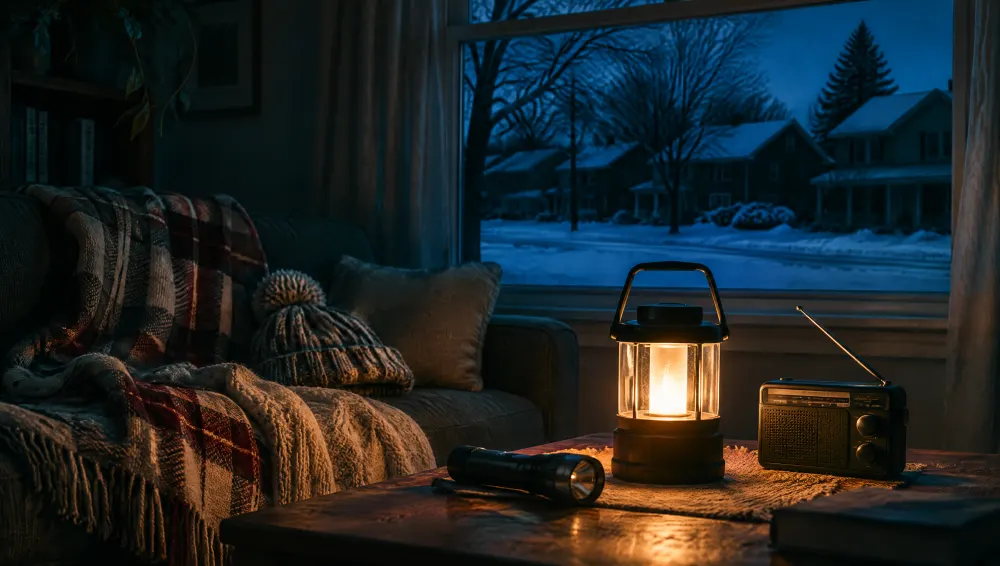
The short answer
When the power goes out you can lose heat, lights and running water, and sometimes internet and phone service too.
- Check whether the outage is only in your home, look at your breaker panel or fuse box, then report it to your power company.
- Use flashlights instead of candles, to lower the risk of fire.
- Unplug tools, appliances and electronics, turn the thermostat down, and leave one light switched on so you can tell when the power is back.
- Keep the fridge and freezer closed. An unopened fridge keeps food cold for about 4 hours, a full freezer for about 48 hours and a half-full one for about 24.
- Get local news from a crank or battery radio, in case the internet is down, and turn on power saving on your phone.
- Keep the heat you have: close the rooms you aren't using, block drafts and dress in layers.
- Never use a barbecue, camping stove, portable burner or fuel-burning generator indoors, including in a garage or basement, even with the windows and doors open.
- If your home gets too cold and it is safe to leave, go somewhere warm until it is safe to return.
Winter power outage supplies to have before it happens
Canada's and Ontario's kit lists both cover at least 3 days (72 hours). The table shows the items that matter most when the power is out in winter, and what each official list says about them.
- Keep flashlights, with batteries, where you can reach them in the dark.
- Have working smoke and carbon monoxide alarms with battery backup. You can't see or smell carbon monoxide, and alarms wired into the house won't work while the power is out unless they have a battery backup.
- Have at least one phone that doesn't need electricity. Cordless phones won't work when the power is out.
- Protect TVs and computers with a surge-protecting power bar.
- Learn how to shut off the water in your home. Pipes can freeze during a winter outage.
- Keep the fridge at or below 4°C (40°F) and the freezer at or below -18°C (0°F), with a thermometer in each. Before a storm, Ontario suggests turning both colder to protect your food.
- Keep your gas tank at least half full, or your electric vehicle charged, when an outage is likely. Ontario's advice is to keep it half full at all times.
- Check and refresh your kit twice a year. The clock change in spring and fall is an easy reminder.
| Item | Canada's kit checklist | Ontario's kit list |
|---|---|---|
| Water | 2 litres per person per day, for drinking, cooking and hygiene | 4 litres per person for each day |
| Food | Non-perishable, such as canned food, energy bars and dried foods, replaced once a year | Non-perishable and easy to prepare, enough for 3 days |
| Light | Wind-up or battery-powered flashlight | Flashlight, headlamp or glow stick |
| Radio | Wind-up or battery-powered | Crank or battery-run |
| Batteries | Extra batteries and battery packs | Extra batteries |
| Phone power | Mobile phone charger and power bank | Backup chargers and power banks |
| Cash | Smaller bills and coins | Small bills |
| Medications | Prescription medications and medical equipment | Medications, and medical supplies and equipment |
| Candles | Listed under additional supplies, with waterproof matches or a lighter, stored safely | Candles and matches or a lighter |
| Warm bedding | Sleeping bag or warm blanket for each person, in a grab-and-go bag | Sleeping bags or blankets, with the supplies for leaving home |
| Winter clothing | Swap in warm clothing, gloves, socks and heat packs each fall | Seasonal clothes, hats and gloves, with the supplies for leaving home |
In the first hour of a power outage or blackout
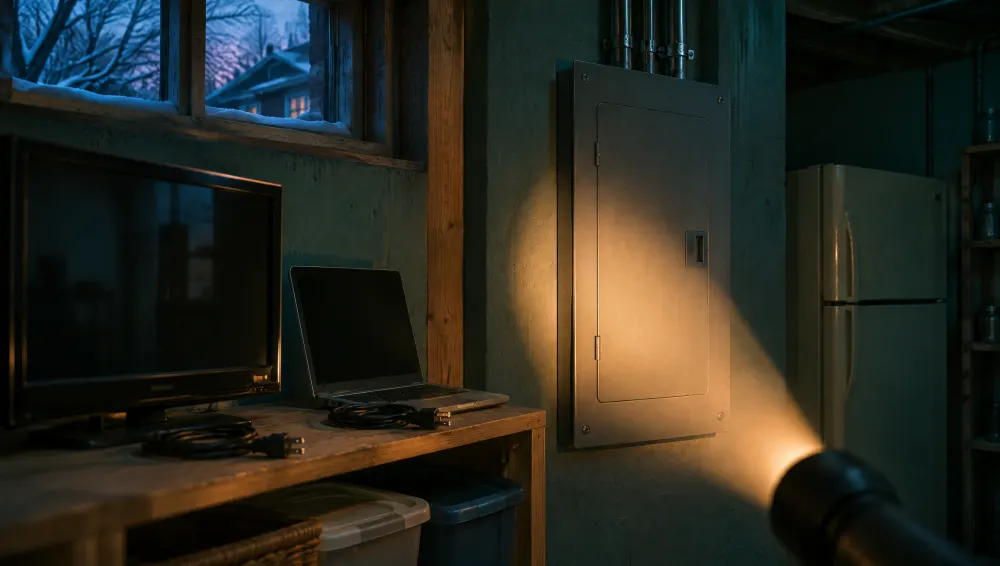
A blackout is a power outage across a whole area. Either way, first find out whether it's only your home, then protect your electronics from the surge when the power returns.
- Check whether the power is still on elsewhere, and ask your neighbours.
- Check your breaker panel or fuse box. Don't touch it with wet hands or while standing on a damp floor.
- Report the outage to your power company, and ask how widespread it is.
- Turn off and unplug appliances and electronics. Canada's page says to unplug all of them; Ontario's says everything except the fridge and freezer.
- Make sure electric stove elements and small appliances are off or unplugged, to prevent fires when the electricity comes back.
- Turn the thermostat down, to prevent damage from a power surge when the power is restored.
- Leave one light switched on inside, so you know when the power is back, and one outside, which also tells utility workers.
- Check the batteries in your smoke and carbon monoxide alarms.
- Tune a crank or battery radio to a local station for updates from your power company and local officials.
- Stay off the road unless you need to travel. Traffic lights may be out.
Light during a blackout at night: flashlights, not candles
Canada's and Ontario's outage advice both put flashlights ahead of candles, because they lower the risk of fire. Candles still appear on both official kit lists, so the fire safety advice for using one is here too.
- Use flashlights or battery lanterns instead of candles or hurricane lamps.
- A headlamp or a glow stick also counts as a portable light on Ontario's kit list. Canada's list pairs the flashlight with extra batteries and battery packs.
- If you do use a candle, Ontario's fire safety advice is to put it in a secure holder with a glass chimney over it, away from children and pets.
- Store candles safely, with waterproof matches or a lighter, as Canada's list puts it.
Your phone and radio when the power is out
Phone batteries run down and networks get busy. ISED's advice is to keep calls short and use text where you can.
- Limit your phone use if you can't charge it, and turn on power saving on your phone and other battery devices.
- To make the battery last, dim the screen, switch to airplane mode and close apps.
- Texts, email and social media use less network capacity than calls, and may work when phone service has been disrupted.
- If you must call, keep it brief and say only what's vital. Avoid sending photos and video.
- A traditional landline may still work in an outage, but you may need a corded phone. Most cordless phones need power.
- Some crank radios can also charge a phone. Check the manual before you count on it.
- If you charge a phone or warm up in the car, never let it idle in a garage, even with the garage door open.
Keeping warm on the first night

Our guide to heating your home without power covers heat sources, carbon monoxide alarms, generators, pipes and the signs of hypothermia in full. These are the basics for the first night.
- Close the rooms you aren't using and block drafts.
- Dress in layers, and use blankets or sleeping bags. Wool and synthetic fabrics insulate better.
- Wear warm socks, gloves, a hat and a scarf, and change out of anything wet as soon as you can. You lose heat faster when you're wet.
- Never use a barbecue, camping stove, portable burner or fuel-burning generator inside, including in a garage, basement, crawlspace or shed.
- Run a portable fuel-burning generator outdoors only, at least 6 metres from any building. That's 20 feet. Point the exhaust away from open windows and doors.
Food in the fridge and freezer during a power outage
Health Canada's times assume the doors stay shut, so open them only when you need to.
- Check the fridge and freezer thermometers to judge whether food is still cold or frozen enough.
- For a full freezer, Canada's outage page gives a range instead: 24 to 48 hours with the door closed. Health Canada and Ontario give about 48 hours, as the table below shows.
- If you know the outage will be long, Health Canada suggests asking someone who has power whether you can keep your food in their fridge or freezer.
- Official advice differs on putting food outside. Health Canada says not to place frozen food outside, even in winter: animals can get into it, and the sun can thaw it even when it is very cold. Ontario's page says to store food outside in winter if you know the power will be out for a long time.
| Appliance | Health Canada | Ontario |
|---|---|---|
| Unopened fridge | About 4 hours | 4 hours |
| Full freezer | About 48 hours | 2 days |
| Half-full freezer | About 24 hours | 1 day |
Water, and what to do if you're on a well
An outage can cut off water as well as power. On a well, the electric pump is what draws the water and keeps the pressure up in your home.
- Official amounts differ. Canada's emergency kit checklist says 2 litres per person per day, for drinking, cooking and hygiene. Health Canada's food and water page says 2 litres, and suggests 2 more for cooking and cleaning. Ontario's list is 4 litres per person per day.
- Ontario suggests filling your bathtub, if you can, to flush the toilet during the outage. Its page doesn't say whether that applies to homes on a well.
- On a well, Health Canada's advice is different: while the power is out, don't open taps, take showers or flush toilets.
- The reason is that water pressure normally keeps contaminants out of the system. Using the water while the power is out lowers that pressure and raises the chance of contamination.
- Have your well water tested before you use it if the system loses all its pressure, or no water comes out of the taps.
- If you rely on a well, Ontario suggests a backup generator to power the pump. Get advice from a licensed electrician before you install one.
- When the power is back, let the water run for a few minutes to flush stagnant water from the lines, and check that any treatment system is working properly.
Check on neighbours and anyone who relies on power
Ontario's planning advice is to identify anyone nearby who may need help, and arrange to check in on them during an emergency like a power outage.
- Check on older relatives and neighbours to make sure they are warm enough and have enough supplies. They may not be able to go out safely for food or medication.
- Think about who nearby may need a hand: an older neighbour, someone living alone, someone new to the street.
- Babies under 1, adults 65 or older, people in poorly insulated homes with no heat or power, and people with some medical conditions or on some medications are at greater risk from the cold.
- If someone at home relies on a medical device that runs on electricity, refrigerated medicine, or a device that needs the internet, make a power outage plan for it with their doctor before winter, and follow it when the power goes out.
- Keep a list of the places that provide life-sustaining equipment or treatment.
- If you use a medical alert system, make sure it will work during a power outage.
- In an apartment, plan a way out without the elevator, and tell property management if you may need help leaving.
If the power is out for more than a day
Canada's advice is to be ready to leave if your home becomes unsafe because of extreme cold.
- Some local governments open warming centres during extreme cold. Check with your city or municipality, and follow its updates by radio.
- If your home is too cold and it is safe to leave, Ontario's advice is to go somewhere else until it is safe to return.
- Go to the nearest heated place at the first signs of exposure to extreme cold, such as numb fingers or toes.
- If you leave, take your emergency kit, listen to local officials, and know your routes, since cell and internet service may be down.
- If there is time, turn off the main breaker before you leave.
- Pipes can freeze in a winter outage. Canada's advice is to run a trickle of water if they can't be kept above freezing, or to drain the plumbing. The heating guide covers both.
- If you need to drive, check road conditions first, and know how to open automated doors, including your garage door, by the manual release.
Downed power lines outside at night
Always treat a downed, sagging, low-hanging or damaged power line as live, even if it isn't sparking or making any sound.
- Keep yourself, children and pets at least 10 metres (33 feet) away. Wires that have been down for several days could still be live.
- Never touch a downed line or try to move it, and keep away from anything touching it, such as a tree, fence or vehicle. Those can carry the current too.
- Electricity spreads through the ground around a fallen line. BC Hydro says the voltage drops to zero at around 10 metres, which is where the distance comes from.
- Report it. Canada's advice is to report downed lines to the officials in your area, and BC Hydro's is to dial 911 and say a power line has fallen or is damaged.
- If someone may still be in contact with a power line, don't touch them. The current can travel through them into you. Stay back 10 metres and call 911.
- If a wire falls on your vehicle, stay inside unless it's unsafe to, and call for help.
- If you have to get out, jump clear of the car and land on both feet, then shuffle along the ground until you are 10 metres clear of any downed lines.
When the power comes back
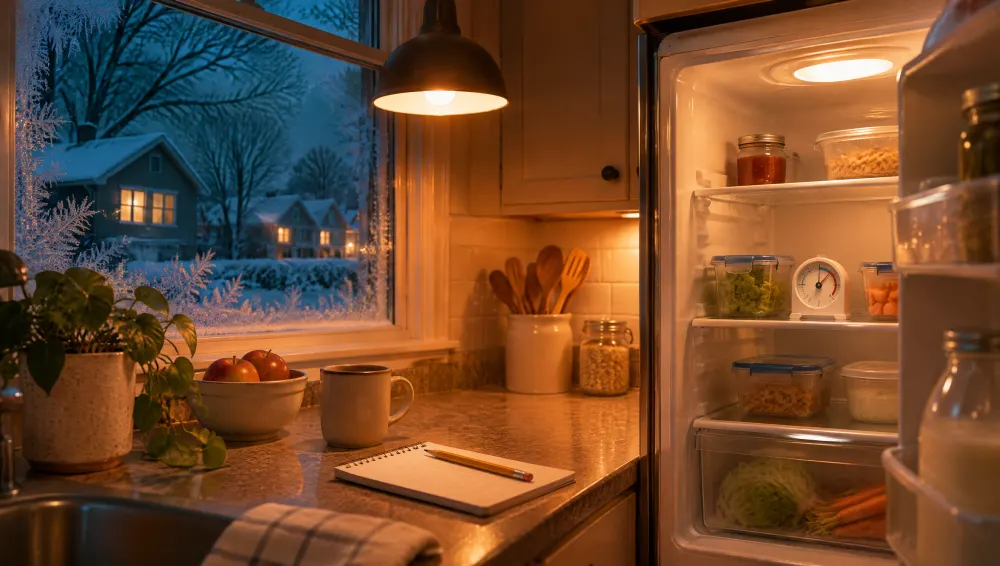
Give the electrical system a chance to settle before you reconnect everything.
- Turn the heating thermostats up first, then reconnect the fridge and freezer.
- Wait 10 to 15 minutes before reconnecting other tools and appliances, and turn them back on slowly.
- Make sure the hot water heater is full before you turn its power on.
- Check frozen food. Food that still has ice crystals or feels as cold as it would in the fridge can be refrozen, and is safe to eat if cooked to a safe internal temperature. Check with a digital food thermometer.
- Throw out food that has been at room temperature for 2 hours or more, and anything with an unusual colour or smell. Food with bacteria doesn't always smell bad or look spoiled.
- When in doubt, throw it out.
- If raw meat leaked as it thawed, clean and disinfect everything its juices touched.
- Call an electrician if you notice any damage to your home's electrical system.
- Watch for signs of illness afterward. Health effects from extreme cold can take up to a few weeks to appear.
Questions people ask
How long does food last in the fridge when the power goes out?
About 4 hours if the door stays closed, Health Canada says. A full freezer keeps food frozen for about 48 hours and a half-full one for about 24. Afterward, throw out anything that sat at room temperature for 2 hours or more.
Can I put food outside in the snow during a power outage?
Health Canada says not to place frozen food outside, even in winter: animals could get into it, and the sun can thaw it even when it is very cold. Ontario's outage page says to store food outside in winter if you know the power will be out for a long time, so official advice differs here.
Should I use candles during a power outage?
Official advice is to use flashlights or battery lanterns instead, because they lower the risk of fire. If you do light a candle, Ontario's fire safety advice is a secure holder with a glass chimney over it, away from children and pets.
What should I do during a blackout at night?
Find a flashlight, then check whether the outage is only in your home and look at your breaker panel or fuse box. Report it to your power company, unplug electronics, turn the thermostat down, and leave one light switched on so you'll know when the power is back.
Source: Canada: power outages
How far should you stay from a downed power line?
At least 10 metres, and keep children and pets back too. Ontario notes that wires that have been down for several days could still be live. If a wire falls on your car, stay inside unless it is unsafe to, and call for help.
Can I use my gas stove for heat when the power is out?
No. Canada's advice is that a natural gas stove can be used to prepare food during an outage, but not as a heating source. A natural gas fireplace can provide warmth until the power is back.
Source: Canada: power outages
Should I flush the toilet during a power outage if I'm on a well?
Health Canada says not to. While the power is out, don't open taps, take showers or flush toilets, because using the water lowers the pressure that keeps contaminants out of the system. Have the water tested if the system loses all its pressure.
Source: Health Canada: well safety during and after emergencies
How do I keep warm in a power outage at night?
Nova Scotia's advice for staying warm at home is to block drafts, close unused rooms and bring pets indoors. Change out of wet or sweaty clothes right away. The heating guide covers what you can and can't use for heat.
In an emergency, call 911. WeVenture isn't an emergency service.
This guide is a plain summary of official advice, not a guarantee, and no single plan fits every home. Follow local officials in a real emergency.
Where this comes from
- Canada: power outages
- Ontario: power outages and blackouts
- Health Canada: food and water in an emergency
- Health Canada: well safety during and after emergencies
- Canada: extreme cold
- Ontario: fire safety at home, power outages
- BC Hydro: safe distance from downed power lines
- Canada: emergency kit checklist
- Ontario: be prepared for an emergency
- ISED: steps to stay connected
- Health Canada: extreme cold and your health
- Nova Scotia: extreme cold health safety tips
Practise it, then compare notes
One small challenge a week, done at home, then compared with other people under a handle you pick. Lessons end in a skill, and your plan stays yours alone.
Start this week